-Sieyes’ state, with weird constitution
-Consul of Interior absorbs power gradually
Data from area.xlsx (Full list)
Heads of France
French Republic
Area
Parts of the French Republic
Country folders/Europe/France/Area/Religion
Companies
CTP
Le Moniteur Universel
Empire
French Daughter Republics
French Sister States
Government
Country folders/Europe/France/Government/Government
National Holidays
Personalities
French Personalities
Jean-François Champollion
Wars
War of the French Revolution (1792-1804)
Second French War (1821-32)
France's Wars
Statistics
Name - République française (French)
Continent - Europe
Capital - Paris
Administration
Head of state - Grand Elector Stanislas du Leyen
Head of government - Consul of the Interior (and President of the Council of State) François Díaz
Legislature - Council of State & Tribunate (initiative), Legislative Body (decision)
President of the Tribunate - Marie-Odette Martin
First Tribune - Youri Fiodoroffe
President of the Legislative Body - Nicole Bodier
Conserving body - College of Conservators
President of the College of Conservators - Michel Horvath
Judiciary - Grand Council of Revision
President of the Grand Council of Revision - Laurent Schwartz
Form of government - Unitary republic under a democratic solonic consular constitution
Form of law - Cambacérès Code
Demonym - French
Geography
Area - 627,875 km^2
Largest cities
-Paris - 9,715,000 (city), 24,677,000 (metro)
-Aix-la-Chapelle [Aachen] - 2,113,000 (city), 9,412,000 (metro)
-Anvers [Antwerp] - 1,523,000 (city), 3,632,000 (metro)
Time zone
-TMP+00:00 (mainland)
-TMP-04:00 (Saint Pierre and Miquelon, Macapá Celedrome Concession)
Currency - French franc
Demography
Language - French
Religion - None (official); Roman Catholicism, Independent Catholicism, Eastern Orthodoxy, Lutheranism, Methodism, Calvinism, Judaism, Islam (recognized)
Population - 131,324,241
Density - 209.16/km^2
Symbols
National festivals
-Equality Day (January 21) - commemorating the execution of Louis XVI (1793)
-Constitution Day (May 3) - commemorating the Glorious Reform (1824)
-Bastille Day (July 14) - commemorating the Storming of the Bastille (1789)
-Reunion Day (August 10) - commemorating the Storming of the Tuileries (1792)
-Republic Day (September 22) - commemorating the Declaration of the Republic (1792)
Anthem - La Marseillaise
Motto - Liberté, égalité, fraternité
Government
Grand Elector
-head of state
-literally just appoints the Consuls
-selected by College of Conservators by
-the College holds one secret ballot each year, placed in secure, sealed urn, and oldest urn (of six) destroyed and replaced
-when a Grand Elector dies, the College selects an urn by vote w/o knowing its contents
-and then whoever has the most votes in urn (and is still living) becomes Grand Elector
-serves for 20 year terms
-may be recalled by College of Conservators, and if is becomes member of itExecutive Power
Consuls
-executive power is vested in complex apparatus led by Consul
-Consul of the Interior is the effective head of government
-there is an additional Consul of the Exterior, subsidiary and essentially leads the military and that's it
-Each Consul appoints and dismisses their own Chamber of Political Justice, which:
-lays fixed penalties against ministers, state councillors, and high judges
-prevents negligence, corrects mistakes, and ensures rapid and regular administrationMinisters
-Under the Consul of the Interior are the:
-Domestic Superintendency, with the Ministers for General Sub-Delegation, for General Instruction, for Public Property, and for National Insurance
-National Magistrature, with the Ministers for Civil and Rural Police, Tutelary Police, Judicial Prosecution, and Law Enforcement
-Superintendency of Finance, with the Ministers for Assessment and Collection of Taxes, and the Treasury
-Under the Consul of the Exterior is the:
-Superintendency of Foreign Affairs, with the Ministers for Foreign Affairs, the Army, the Navy, and the Colonies
-Each minister has their own agents and functionaries
-They have a Chamber of Ministerial Justice which operate under the same principles as the Chamber of Political JusticeLegislative Power
-The legislature consists of a Council of State, the Tribunate, and the Legislative Body
-in effect law is decided sort of like an adversarial trial
-with Council of State and Tribunate opposing powers of a trial
-and the Legislative Body serving as the judgeLegislative Body
-The Legislative Body is:
-elected in four-year terms staggered by each year in department by proportional representation
-with each department (or departments gathered together) assigned to one term
-ratifies laws proposed by either the Tribunate and Council of State silently
-each of which sends 3 members to discuss members in front of them
-during this period, the centerpiece of the entire legislative arrangement, Legislative Body is silent
-only talks during committees, including Committees of the Whole
-and this is where it investigates the functioning of the government and all
-552 membersCouncil of State
-The Council of State is:
-appointed by the Consul of the Interior from the National Notables
-executes, drafts, and proposes laws
-makes regulations binding on functionaries
-often talks in closed sessions, and open sessions fairly commonly act like discussions with the people nowadays
-50 members-appoints Court of Administration which
-adjudicates administrative grievances concerning the ministers, from subordinate officials or citizensTribunate
-The Tribunate is:
-selected from the remainder of the National Notables
-represents the opposition, the "people" against the "government"
-drafts and proposes laws
-opposes and debates the Council of State
-refers laws for constitutional review
-with 1-year limit and it may only call 1 law for review per year
-practically, this means government tries to pass as many laws as possible and tribunate only issues laws for review if it's sure College will annul (it rarely is) and with majority needing to be corralled tough
-leader of the leading opposition party is typically First Tribune, elected for that purpose
-50 membersConserving Power
-The conserving power consists of the College of Conservators, which:
-has 15-year terms
-due to deaths and all these terms are essentially random
-meets only once a year
-operates the Republican Guard
-appoints the Grand Elector, and removes if necessary
-annuls unconstitutional laws
-only if the Tribunate issues an official protest within 1 year
-puts up proposed constitutional ameliorations in plebiscites
-appoints member proposed by legislature
-100 members-the College of Conservators appoints four permanent chambers to protect the people
-Chamber of Military Correspondence
-Chamber of Political Rights
-Chamber of Accounts
-Chamber of Censors
-has influence on power of the purseJudicial Power
-National Court
-consists of 1 judges per department nominated by government and legislative body, confirmed through College of Conservators
-a collection of Grand Judges practically speaking-Grand Council of Revision
-50 judges
-annuls decisions of lower courts for
-non-observance in judicial forms
-variation of case law in the same court
-dissimilarity of case law in the various courts
-may also refer judgements to neighboring court-Grand Council of Police
-6 judges
-find the perpetrators of crimes committed to deliver them to justice
-leads the Public Prosecutor's Office-Political Tribunal
-49 judges
-judges offenses committed by officials of government, including by judges of common courts-High Court
-5 judges
-meets only intermittently to deal with offences of high functionaries
-charges may only be laid by Legislative Body
-which appoints prosecutors from Grand Council of Police
-guilt determine by National Jury of 28 members
-consisting of 83 nominees chosen annually by National NotablesNotables
-The notables are elected by the people, prop. by department/communes
-25*(#dept) national notables, from whom consuls, ministers, and select servants selected
-250*(#dept) departmental notables, from whom prefect and select servants selected
-500*(#commune) communal notables, from whom mayor and select servants selected
-these are nominees for national offices
-every legislator, minister, other official must come out of these lists
-discluded notables are thence removed from the pollsElection System
-every three years, citizens elect the Notables - all three tiers
-elections are by open list proportional representation
-and parties of all different types by low petition can put their ballots in official rooms
-people cannot confirm or reject candidacy which means parties have virtually no control over departmental or communal notable lists
-with deaths, disqualified, etc. requiring bypolls-every three years, citizens elect from the national notables 100 people as National Representatives
-nominations done by petition and payment of fee to authority
-parties assured of getting slates through
-but additional entities give their own slates, largely of party-nominated candidates of diff orders
-Representatives elect a Council of State of half of itself
-and Grand Elector appoints someone from Council of State as consul
-this means any Consul needs approval of majority of National Representative Council-Every year, one third of Legislative Body members put up for election
-citizens from relevant departments elect from national notables (any) their legislators-practically, this results in what is often called a perpetual election across France
Flag

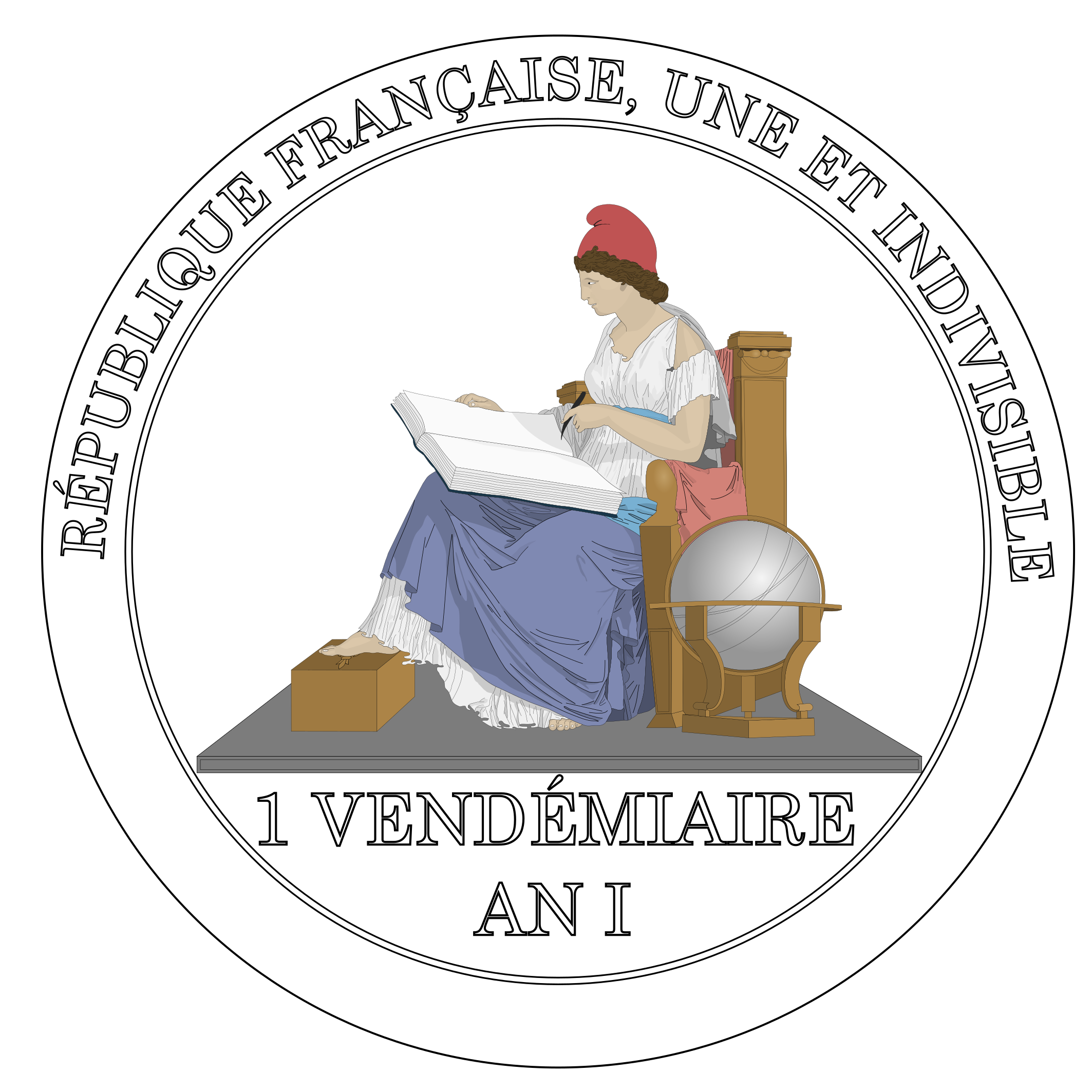
Seal
National Holidays
Name Date Notes New Years' Day January 1 Equality Day January 21 Commemorates the execution of Louis XVI by the French people (1793) Victory Day March 15 Commemorates the French victory in the French Wars > Fifth French War (1892-5)) Easter Monday Floating Workers Day April 23 Commemorates the Aix-la-Chapelle > Cour de Katche riot (1877) Constitution Day May 3 Commemorates the Glorious Reform (1824) of the French Constitution Joan of Arc Day May 30 Commemorates the martyrdom (1431) of French national hero Joan of Arc Bastille Day July 14 Commemorates the Storming of the Bastille (1789) Reunion Day August 10 Commemorates the Storming of the Tuileries (1792) Mother's Day August 15 Still often known as Assumption Day, as it was known prior to the Amendments to the Concordat (1857) Republic Day September 22 Commemorates the Declaration of the French Republic (1792) Veterans Day October 3 Commemorates the end of the French Wars > Fourth French War (1880-4)) All Saints' Day November 1 Christmas December 25 Second Day of Christmas December 26 Still often known as St. Stephen's Day, as it was known prior to the Amendments to the Concordat (1857) Equality Day
-regarded as somewhat garish to celebrate an execution
-but nevertheless has a fair amount of significance beyond that
-celebrates equality of the nation in generalWorkers Day
-the Cour de Katche riot was hallmark of labor movement and commemorated
-made official by Heads of France > 1898-1901 Alexandre Bourgeois (Social Radical - Association of Mechanics and Peasants coalition)Constitution Day
-commemorates the amendment to the French constitution bringing France farther along the road to democracy
-instituted by Heads of France > 1824-1836 Bernard-Francois de Chauvelin (Coppetard) †-†)
-to commemorate the Coppetards' rise to powerJoan of Arc Day
-long revered by French people as symbol of the nation
-but renewed by Country folders/Europe/France/Area/Religion > Independent Catholicism in France, which makes her their leading saintBastille Day
-chief national day of France
-world-famous military parade on this dayMother's Day
-idea of motherhood strengthened by France being constantly at war
-idea that Assumption Day represents some sort of general motherhood strengthened by this
-and as part of secularizing reforms Assumption Day turned to Mother's DayVeterans Day
-instituted with military defeat of French Wars > Fourth French War (1880-4))
-to provide for memoriam of dead not only of this war but of all wars
Constitution
.png)
Religion
Religion Percent Population Roman Catholicism 35.4% 46,488,781 Independent Catholicism 15.4% 20,223,933 Protestantism 12.6% 16,546,854 Orthodoxy 8.8% 11,556,533 Islam 4.2% 5,515,618 Judaism 4.1% 5,384,293 None 12.6% 16,546,854 Unaffiliated 4.8% 6,303,564 Other 2.1% 2,757,809 Total 100% 131,324,241 (Estimated from a panel of 30,000 randomly selected residents, 2021)
Roman Catholicism
-eroded by mass immigration and Independent Catholic schism
-eventually loses its majority status at around 1900
-and erodes further due to disenchantment of religion with French Wars > Sixth French War (1937-41))Independent Catholicism
-Independent Catholicism is the result of a much larger split over papal infallibility, with many breakaway clergy taking away their laity with them
Gallicanism
-in France the rise of the Gallican Independent Catholic Church isn't as big as elsewhere
-no bishops involved and French state intervenes on side of Roman Catholics
-still pretty big and Gallican Church now second biggest religion in France
-there's still a pretty impressive religious revival in France in this era
-Gallicanism incorporates the very populistic laity traditions
-and obtains church of Paris > Grande Basilique de Ste. Jeanne d'Arc which is major tourist attraction
-boosted a fair bit by immigration of Independent Catholics from other countries
-especially FilipinosGallican Independent Catholic Archbishop of Paris (and Gallican Primate of France): Jean-Jacques Marais
Roman Constitutional Catholic Church
-additionally Italian immigrants from its church have formed their own organization based on United States of Italy > Independent Catholic religion
Roman Constitutional Cardinal-Archbishop of Paris: Antoine-Aimé Napoli
Protestantism
-Protestantism dramatically expanded by, first, annexation of chiefly Protestant French Switzerland, and second, by massive amounts of immigration from Protestant countries (chiefly Germany and Sweden) in 19th century
-and then with immigration of Africans, including a lot of Methodists (converted by Colored-Americans)Lutheranism
-mostly consisting of Rhenish French people, as well as German and Swedish immigrants
President of the Central Consistory of the Evangelical Church of the Augsburg Confession of France: René Anderssen
Calvinism
-Huguenots are root and famous section of this
-and extended with annexation of French parts of Switzerland
-making Geneva center of French Protestantism
-and then a lot of immigrant come in and spread Calvinism further
-despite it, French Calvinists strongly identify with Huguenot legacy in general
-and Huguenot cross very popular garb among themPresident of the Central Consistory of the Reformed Church of France: Pierre Reuter
Methodism
-rise of Methodist movement in Geneva creates a small community
-then there's a not unsubstantial degree of conversion from other Protestant denominations and even a small number of Catholics
-then booms with mass immigration of Africans
-with many in France's African empire having been converted by Colored-American missionaries
-result is formation of French Methodist Church with chiefly immigrant makeup
-not episcopal because that's simply opposed by oldline Methodists who view having a bishop as Catholic
-but nevertheless deeply inspired by African Methodist Episcopal ChurchPresident of the General Conference (and of the Council of Superintendents) of the Methodist Church of France: Isaïe Oudjame
Orthodoxy
-Orthodoxy is the product of great amounts of immigration from Eastern Europe, incl. many people from erstwhile Ottoman Empire, and then formation of a French Exarchate w/ exarch recognized by Constantinople (but partially successful)
French Exarchate
-formed to unify various immigrants under a national church
-and including a lot of Little RussiansExarch of France: Serge Sinitsine
Russian Overseas Church in France
-formed by later Russian immigrants
-headed by Russian-appointed bureaucracy but in practice they only appoint locals and incorporate local wishes
-to prevent a splinterPresident of the Holy Synod of the Russian Overseas Church in France
French Coptic Orthodox Church
-a lot of Copts immigrate to France under colonial rule
-additionally goes on to include Abyssinian immigrantsPrimate of the French Coptic Orthodox Church: Marcos II
Islam
-Islam is result of immigration as much as OTL, but with more immigration from East Indies
-with the rise of an increasingly large Muslim minority governed by France it's organized into consistory
-to keep it controlled by France and integrate it into the system
-creating a very diverse Islamic population
-of Malayan peoples, North Africans, East Africans, etc.President of the Islamic Central Consistory: Achmet Larbaoui
Judaism
-known as Israelites within France
-vast majority of French Jews are Ashkenazi due to mass migration from Germany and Eastern Europe
-only recently is there a migration of (Sephardi) Near Eastern Jews which, however, does not match Ashkenazi
-headed by Israelite Central Consistory, which elects a Chief Rabbi
-Consistory is a coalition of Reform and Orthodox sections which each have parallel conversations and are only really unified by convenience
-without Napoleon, Jewish emancipation happens decades later in much of Europe
-and so a lot of German Jews immigrate following stuff like Hep-Hep riots (worse due to identification of Judaism with France)
-and more immigration from Russia and Lithuania afterwards because a lot of Jews view it as a cause to bring them inChief Rabbi (and President of the Israelite Central Consistory) of France: Moïse Abramouitche
Parts of the French Republic
-see Parts of the French Republic
Infrastructure
Railways
-French Republic a lot more happy about laying down railways than OTL
-with it having a lot more coal fields with Belgium, Sarre, and part of Ruhr
-and needing to maintain national security in much more hostile Europe
-Pierre Michel Moisson-Desroches presents proposal in 1814 to make seven major railway tracks to centralize nation
-Paris to Genoa by Lyon and and Marseilles
-Paris to Bordeaux
-Paris to Nantes
-Paris to Le Havre, by Rouen
-Paris to Calais, by Boulogne
-Paris to Gand, by Lille
-Paris to Mayence
-proposal gets accepted, French government immediately gets to work, focusing on Paris to Lille first
-opens railway from Paris to [insert suburb here] in 1817 with steam locomotive passing to and from it
-gauge of one and a half metres, based on cart size
-extended to Saint-Denis in 1823, construction up to Roissy-en-France planned
-that, too, constructed in 1832 (delayed by war)
-by 1834, railway has reached Creil, and construction backwards has begun on railway from Lille to Arras
-along with subcontractors developing railway to and from Mayence, additionally from Aix-la-Chappelle to Cologne
-by 1837, railway from Paris to Lille constructed
-by 1844, all these proposed railroads constructed incl. one from Lille to Cologne, and railway built to Milan too (with others built in Italy)
-in addition, work begun in 1833 on Turin-Modane railway, with big obstacle being Mont Cenis
-relatively new innovation of percussion drill used in US (American Infrastructure > Pennsylvania Mainline Canal) crucial to this
-railway opened in 1849, thanks to new tech
-and during French Wars > Third French War (1847-54), railroads constructed to Sarrebruck, others along German border
-postwar a lot of private companies get in on the business, but they do a lot more localized ones but with state pushing through powerful control
-and railroads built across the Rhine as well
-rising density of railroads, particularly in the eastern part, although with state control of most important railroads and very much regulation of the rest, no Railway Mania equivalent
Grand chemins
-highways
-following French Wars > Sixth French War (1937-41) France constructs a series of highways across the nation
-eventually comes oil shocks of the 1950s with Near Eastern wars of independence
-also comes the rise of railroads in its place
Canals
-Rhine-Rhone Canal
-Marne-Rhine Canal
-Canal de Bourgogne
Colonies
Laurent Marques
French-aligned states in East Indies
-Sultanate of Maguindanao
-Sultanate of Sulu
-Zamboanga Colony
-Sultanate of Aceh Darussalam
-initially able to keep independence due to anglo-dutch rivalry
-dutch invasion begins in 1887, but sultan calls for jihad
-procures large french arms, dutch fail to get aristocracy on side
-eventually in 1894 dutch leave with face-saving measures
-large chinese immigration as part of reconstruction, causes some issues
-french protection now a thing, but france unable to enlargen influence greatly-Sultanate of Kedah
-france goes to war with siam, forces it to give up malay suzerain states
-unifies kedah and partitioned kingdoms of setul, perlis, and kubang basu, incorporates terang into it
-british control of penang means france cannot centralize rule over kedah, means it stays indep for most part-Sultanate of Patani
-france goes to war with siam, forces it to give up malay suzerain states
-unifies patani with kelantan
-france centralizes power to a degree over patani, but can't go all the way-Sultanate of Terengganu
-france goes to war with siam, forces it to give up malay suzerain states-Singgora Colony
-annexed by france after war with siam
-turns into major trade port, sees widespread migration
-results in muslims (majority malay) becoming plurality
-but thai, chinese people major presence as well-Clangue Colony
-dispute over succession in Clangue, selangor causes civil war in 1880s where france intervenes
-results in france gaining selangor as influenced territory, also gets Cangue more strongly
-eventually gets Clangue as formal colony to develop as port-New Guinea Colony
-includes almost all of the island of new guinea
-except for western bits ruled by dutch-aligned ternate and and stuff south of 8th parallel ruled by british australia
Protectorate of Lagos
-in 1825, France, having long had a presence fighting slave trade intervenes in Lagos and restores Adele Ajosun as Oba of Lagos
-in 1827, British Isles ships storm in, remove Adele Ajosun after ship battle, and then put Osinlokun back
-but soon afterwards, word comes of British Wars > Popular Revolution (1827-9), French ships attack again, and British ships confused retreat and move to Sierra Leone
-French move back in
-his son Oluwole succeeds as Oba in 1837
-realizing French are trying to make him a puppet, tries to kick them out in 1843
-but they rally behind Akitoye, prop up his ambitions and send ships up and make him Oba in 1844
-in return for ban of slave trade and permanent military presence
-makes Lagos major port and base for whole region
-growth of commercial zone of influence with palm oils
-missionaries frowned upon and often kicked out
-in 1859, full ban on slavery issued
-French rescuees from many (particularly Portuguese) ships put there
-also Afro-Brazilian diaspora (Amaros) comes here, creating sizeable creole group which makes up a quite large proportion
-resulting in Lagosien architecture being deeply based on Brazilian architecture
-and Portuguese-based creole influential, Portuguese co-official
-also there's Afro-Brazilian expansion into interior in 1860s
-use their guns to make themselves in high positions within Yoruba states
-result in many wars and adoption of modernized rifles
-allows Sokoto to expand its conquest southwards because this draws a lot of Yoruba troops
-rail-building to and from French outposts to Lagos, connecting coastal region
-in the age of colonial nationalization, Lagos becomes the informal capital of France's Niger Coast Protectorate