Statistics
Name - 省联华中 (Chinese) { Jông-Houá Lián-Chêng (Mandarin pronunciation) }
Continent - Asia
Capital - Nanjing
Administration
Head of state and government - Supreme President -------
Legislature - The Six Boards and the Board of One Hundred and Eight (initiative), National Conference (decision)
President of the Board of One Hundred and Eight - ---------
President of the National Conference - --------
Financial assembly - Board of Finance
President of the Board of Finance (and Minister of Finance) -
Conserving body - Board of Supervisors
President of the Board of Supervisors - --------
Chief Grand Secretary - -------
Judiciary - Grand Court of Revision
Minister of Justice -
Form of government - Federal republic under a democratic presidential solonic constitution
Form of law - Chinese Code
Demonym - Chinese
Geography
Area - 11,012,557 km^2
Largest cities
-Nanjing - 34,203,000 (city), 36,910,000 (metro)
-Ningpo - 13,039,000 (city), 24,108,000 (metro)
-Guangzhou - 14,527,000 (city), 20,372,000 (metro)
Time zone - TMP+08:00
Currency - Chinese yuan
Demography
Language - Chinese (Mandarin)
Other languages
-Fengtian, Jilin, Heilongjiang, Waimanzhou - Russian, Manchu (co-official)
-Outer Mongolia, Inner Mongolia, Buryatia - Russian, Mongolian (co-official)
-Hami, Dihua - Kashgar Turkic (co-official)
-Formosa - French, Javanese (co-official)
Population - 1,623,574,000
Density - 147.43/km^2
Symbols
National festival - Republic Day (August 21) - commemorating the Declaration of the Republic (1901)
Anthem - 歌雲卿 (Song to the Auspicious Cloud)
Motto - 步进序秩爱 - Love, Order, Progress
Flag
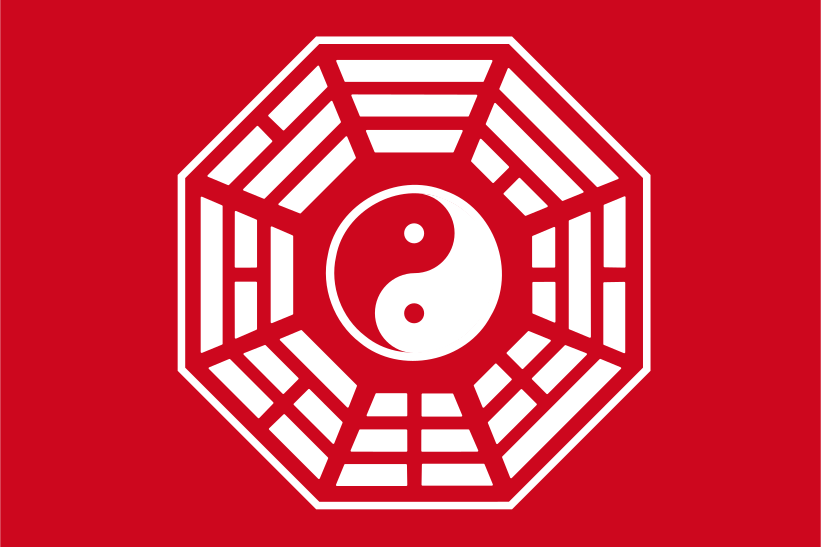
-Eight Trigrams on the flag is a legacy of the Bai dynasty
-the present flag was a war banner which was flown by Marshal Lee during Russo-Chinese War (1893-9)
Government
Name
-United Provinces comes from Ideology > Sociocracy
-which, in its original form, advocated the union of the world in the form of cantonal regions (aka cities)
-Lee Cheng-chang emphasized this provincialism both from this and to get loyalty of governorsExecutive branch
Supreme President
-Supreme President elected by the people for terms of nine years
-very powerful figure who is only limited in terms of appointments by having to appoint National Conference members for cabinet
-does not have a veto but sits on all sessions of the Board of One Hundred and Eight
-can vote in National Conference sessions-full title: "His Elective Majesty, the Supreme President of the United Provinces of China, President of the Six Boards"
-in practice he's a sort of republican emperor
-even performs rituals to heaven at Temple of Heaven upon getting inaugurated
-a temple that, after having been destroyed by the rise of the Bai, got replicated in Nanjing
-Temple of Heaven is also containing a delegation of the people, to represent that the Supreme President gets authority from both Heaven and the People-former presidents are supervisors
Six Boards
-six Boards, each board headed by a Minister
-Board of Revenue is in charge of the treasury
-it acts as a financial assembly and approves of budgets and revises accounts
-and in this is bigger than all the other boards
-Board of the Interior is in charge of police and keeping the public peace
-Board of Various Countries is in charge of foreign affairs
-is a pretty large board as well
-which is important because it keeps track of foreign affairs
-Board of War is in charge of managing the military
-Board of Education is in charge of school system
-Board of Trade manages industry, commerce, labor, and agriculture
-pretty large board which manages a state filled with Ideology > Sociocracy
-contains sub-boards for these different sectors-on occasion meets as a single assembly known as the Six Boards
-presided over by Supreme President-all these Boards and Ministers appointed by President but require approval by National Conference
-and every member of them must be Conference members
-reconstitution of boards upon every National Conference election
-means these Boards also act sort of like National Conference committees
-all these Boards also have the power to propose new legislationLegislative branch
-legislature is divided into National Conference and Board of One Hundred and Eight
National Conference
-National Conference consists of members elected direct by the people in individual constituencies
-essentially a dead assembly with few debates and largely mute
-biggest debate is a sort of Inquest session where President and ministers interrogated by opposition
-when it ratifies laws their results already known, or at least is likely
-and when a law put up to a vote it's done with only a few speeches
-for three year terms
-Conference members elected from 2,085 small constituencies
-voters can vote for any candidate nominated in any constituency by writing them in
-winners have as many votes as people who voted for them
-as long as they meet a threshold of 25,000 votes
-a great many officials must be National Conference members
-so this makes it a repository for national officials
-can remove the president upon recommendation of National Censors with vote of three-fifths
-practically-speaking, this means three fourths of national conference members must concur-the Supreme President can vote in National Conference sessions with a vote equal to as many people voted for them
-this means they have at least as many as half of the votes of the whole
-so at least three quarters vote of National Conference needed to exceed President's vote
-practically speaking this means that with China having multi-party government politics Supreme President is very influential-only meets 50 days in a year
-and for a swathe of the year they travel in circuit around their constituencies to hear feedback and all-Conference members may also be recalled by petition
Board of One Hundred and Eight
-Board of One Hundred and Eight elected by super-constituencies (merged from National Conference constituencies) from already elected National Conference members
-for three year terms
-may propose laws if supported by 36 members
-having been established by Bai dynasty originally in order to accommodate the pro-democracy movement
-when it liaised with Grand Council and was elected by complex of filtered electoral colleges-various other Legislative Boards, each of whom constituted by sortition
-but with highest officials excluded from being selected by lotConserving branch
Board of Supervisors
-Board of Supervisors supervises functioning of all government
-66 members plus ex officio ex-presidents
-selected for terms of twelve years
-candidates are:
-people who have passed jinshi level of examination
-which in practice means that a lot of academics run as Supervisors
-upon election time the current National Conference whittles away its numbers by deselecting one-third of all eligibles, and remainder qualify for election
-elected by the people of province, apportioned by square root of each province's population
-may call byelections in National Conference
-may also exclude National Conferencepeople from eligibility to the Board of One Hundred and Eight
-also supervises examinations and appointments to the civil serviceBoard of National Censors
-appointed by Board of Supervisors is the Board of National Censors
-which investigates all officials from other branches as well as civil servants
-may lay charges against government officials and extract fines
-and also to audit all functioning of the government
-may also lay charges against the Supreme President
-also can recommend to the National Conference the removal of a presidentGrand Secretariat
-Board of Supervisors also appoints the Grand Secretariat
-of five members
-which heads all matters of the civil service
-Chief Grand Secretaryy sits on the cabinet
-and reports findings to Supervisors which meets in closed session to discuss his findingsBoard of Constitutional Review
-also appoints the Board of Constitutional Review
-which determines constitutionality of law based on cases
-with final constitutionality determined by Supervisors after it presents them
-and may nullify with reasoning, and a draft of good law, within two years of the law's passageCivil service
-under the Bai dynasty the civil service examinations got changed from Confucianism to Buddhism
-this gets softened and more Confucianism added after the fact but as a mere supplement
-and also addition of Western canon to it as part of modernization
-because now there's been a hole which can be filled with something
-addition of math and engineering
-degrees also become increasingly specialized
-additionally there's been a dramatic expansion of the number of people who get exams
-as part of Bai wanting to impose itself-by today civil service less prestigious than formerly due to growth of private sector
-but still hella prestigious and high-paying
-with prestige best retained in less wealthy areas
-also degrees can be important in securing private sector jobsDegrees
Juren: At the apex of the provincial system.
Gongshi: Second tier degree, gets almost assured high level civil service job
Jinshi: At the apex of the entire system, assures to whoever gets it one of the position within the bureaucracy and required for Supervisors
Judiciary
Minister of Justice
-Minister of Justice
-heads all judicial affairsGrand Procurator
-Grand Procurator
-manages prosecution through an apparatus of procurators who also accuse and detain
-these are tightly associated with judiciary rather than executive branchGrand Court of Revision
-Grand Court of Revision
-judicial body appointed on dual confirmation of National Conference and Board of Supervisors
-reviews all actions of previous courts and annuls them if necessary
-charges laid by Board of Supervisors are submitted in trial to itProvincial administrations
-provinces run by governors
-governors are appointed by the president but require the consent of at least one third of the provincial assemblies
-each province has a Conference from which is elected a Board of 27
-and the Provincial Conference is similarly oversized (a thousand or more on average)
-however, provinces do not have separate civil services, and Board of Supervisors supervises the provinces
-but, civil servants must first be appointed from among Provincial Conferencepeople
Romanization
| Category | OTL Pinyin Form | TTL Form | Cyrillic |
|---|---|---|---|
| Initials | b | b | б |
| p | p | п | |
| m | m | м | |
| f | f | ф | |
| d | d | д | |
| t | t | т | |
| n | n | н | |
| l | l | л | |
| g | g | г | |
| k | k | к | |
| h | h | х | |
| j | dj | дж | |
| q | tch' | ч | |
| x | ch' | щ | |
| zh | j | ж | |
| ch | tch | ч | |
| sh | ch | ш | |
| r | r | р | |
| z | ts | ц | |
| c | ts' | ць | |
| s | s | с | |
| y | y | й | |
| w | ou | у | |
| Basic Finals | a | a | а |
| o | o | о | |
| e (/ɤ/) | eu | э | |
| i | i | и | |
| u (/u/) | ou | у | |
| ü (/y/) | u | ю | |
| ai | ai | ай | |
| ei | é | эй | |
| ao | ao | ао | |
| ou | o | оу | |
| an | an | ан | |
| en | en | эн | |
| ang | ang | анг | |
| eng | eung | энг | |
| ong | ong | онг | |
| Compound Finals | ia | ia | я |
| ie | ié | е | |
| iao | iao | яо | |
| iu | iou | йо | |
| ua | oua | уа | |
| uo | ouo | во | |
| uai | ouai | уай | |
| ui (/wei/) | oué | уэй | |
| üe | ué | юэ | |
| üan | uan | юань | |
| ün | un | юнь | |
| er | eur | эр | |
| Tone Marks | Tone 1 | acute (á) | ´ |
| Tone 2 | grave (à) | ` | |
| Tone 3 | circumflex (â) | ˆ | |
| Tone 4 | plain / grave | - / ` | |
| Neutral | none | (none) |
Cities
| Rank | City | Province | City proper | Metropolitan population |
|---|---|---|---|---|
| 1 | Nanjing | Nanjing | 34,203,000 | 36,910,000 |
| 2 | Ningpo | Zhejiang | 13,039,000 | 27,108,000 |
| 3 | Chongqing | 16,887,000 | 25,013,000 | |
| 4 | Guangzhou | Guangdong | 14,527,000 | 20,372,000 |
| 5 | Fuzhou | 16,180,000 | 19,885,000 | |
| 6 | Hankou[1]Wuhan | 10,223,000 | 17,211,000 | |
| 7 | Shantou | 7,398,000 | 16,453,000 | |
| 8 | Dali | Yunnan | 9,113,000 | 15,832,000 |
| 9 | Wenzhou | Zhejiang | 10,032,000 | 15,137,000 |
| 10 | Siming[2]Xiamen | 11,443,000 | 14,802,000 | |
| 11 | Hangzhou | 8,329,000 | 14,391,000 | |
| 12 | Xi'an | Hubei | 6,329,000 | 13,947,000 |
| 13 | Jiangmen | Guangdong | 10,318,000 | 13,445,000 |
| 14 | Chengdu | 10,439,000 | 12,932,000 | |
| 15 | Changsha | 9,432,000 | 12,427,000 | |
| 16 | Taiyuan | Shanxi | 7,735,000 | 11,913,000 |
| 17 | Guiyang | Guizhou | 7,361,000 | 11,491,000 |
| 18 | Tieshan[3]Near Beihai | 6,527,000 | 10,793,000 | |
| 19 | Shenyang | 8,312,000 | 10,423,000 | |
| 20 | Haishenwei[4]Vladivostok | |||
| 21 | Lanzhou | 4,247,000 | 10,281,000 | |
| 22 | Lushunkou | |||
| 23 | Nanning | Sichuan | 3,448,000 | 9,438,000 |
| 24 | Kaifeng | Henan | 3,983,000 | 9,201,000 |
| 25 | Yichang | 3,639,000 | 9,094,000 | |
| 26 | Tengyue | Yunnan | 3,653,000 | 8,731,000 |
| 27 | Beiping[5]Beijing | 5,248,000 | 8,462,000 | |
| 28 | Jiujiang | 3,025,000 | 8,093,000 | |
| 29 | Chengzhang[6]Daqing | |||
| 30 | Tsolotoisike[7]Zheltuga |
-the great economic corridor of China is the Yangtze River
-second greatest is the Pearl River
-in contrast Beiping has declined a fair bit from its heyday
-Xi'an is the center of the Yellow river area
-Manchuria was formerly a backwater
-Yunnan having been a quasi-independent state has developed Dali a lot
-Beiping is OTL Beijing
-Chongqing grew due to its position near Nanjing
-Dali is so large due to its history as the capital of the essentially independent state of Yunnan
-Shenyang boomed thanks to its use as a Russian port
-Taiyuan boomed due to the use of the coal deposits nearby since the Bai era
-Fuzhou was a treaty port
-Ningpo so big because British Chusan nearby made it the gateway to China
-Hankou aka Wuhan so big because Nanjing near river
-Haishenwei, formerly Vladivostok, rose rapidly after its Chinese conquest
-Tsolotoisike, Sinicized from Zolotoysk
-Chengzhang grew originally under Russian rule as railroad headquarters
-Sikepoliefusichi, Sinicized from Skobolevsky, from Russian general Skobolev
-Fulajimilofuka, Sinicized from Vladimirovka
-Samajiersike, from Samagirsk
-Shangwutingsike, from Verkhneudinsk
Ethnic groups
Han
-by far the most of them
-dominant and have engaged in programs of assimilationHakka
-due to China's Wars > Hakka-Punti Clan Wars (1855-1860) they become dominant in Pearl River Delta
-leading group in Southern ChinaPunti
-minority in Pearl River Delta
-but patchy majorities some areas
-speaking a Yue language
-due to China's Wars > Hakka-Punti Clan Wars (1855-1860) they are reduced to minority
-with a lot also emigratingHui
-make a slender majority in Yunnan
-due to both conversion and migration of Hui from elsewhere during the Sultanate era
-similar to Han aside from being Muslim
-due to the Yunnan Sultanate engaged in a period of state-building there's been a fair degree of divergence
-for a while, the Sultanate even went as far as to push Arabic as language of state
-before having to go back to employ migrant Hui
-also it formed diplomatic links, imported teachers, with more westerly Islamic states
-however, with the rise of the United Provinces, China's been trying to clamp down on this convergenceTurks
-chiefly in areas adjacent to Central Asia
-most prominent is Hami
-however there's been a considerable degree of Sinicization, only successful in citiesMongols
-make up majority in Mongolia region
-but due to assimilation as well as migration of Han into the region the majority of Mongols speak only Chinese
-and most of those who speak Mongolian are bilingualTibetans
-some of them in China in areas next to Tibet
-a great degree of assimilation has been doneRussians
-in places successfully conquered during Russo-Chinese War (1893-9) some Russians stayed
-though most fled to the Americas or elsewhere
-granted full toleration and all
-mir system formed in area is suppressed
-instead Lee parcels out land in small portions
-with much of the best line getting confiscated and parcelled out to Chinese
-essentially this results in Russian land turning into minifundia
-many Russians forced to either move to Russia to get land or they move to cities
-long term a lot of Russians end up speaking Mandarin as a resultJews
-came along with Russians and often grouped with them
-with Russian Empire expanding the Pale to there
-fewer of them fled the Chinese advance because they had much less fondness for Russian society
-but still some did due to Yellow Peril
-living in cities for the most part already
-because Russia does not exactly want to make a bunch of shtetls
-today most speak ChineseManchu
-during the rise of the Bai, a lot of Manchu get brutalized in reprisals
-result that Manchu in Bai territory forcibly integrated into Han, lose any semblance of Manchu identity
-also, in Qing territory a lot of Han and Hanized Manchurians forced to flee to Manchuria, Mongolia
-this hastens the decline of Manchu culture which is already in there
-there's a modest but still impressive degree of Orthodox conversion among the Manchu
-with Russo-Chinese War (1893-9), Lee Cheng-chang declares full toleration to Manchu
-but at this point Manchu identity is entirely symbolic in nature
-and Manchu language on verge of extinctionTungcheng
-community formed out of Han and Manchu converts to Orthodoxy by Chinese missionries
-also some other Chinese Christians move northward to land under Christian Russian protection
-so named from Chinese word for Orthodox
-with Russo-Chinese War (1893-9) there are military reprisals against Tungcheng despite Lee seeking to tolerate them
-and many flee with Russians
-postwar Lee creates a separate Chinese Orthodox Church with patriarch in Nanjing
-succeeds in obtaining Tungcheng approval after Russia sees Young Russian Revolution (1902-8)
-successfully integrated into Chinese state in years that follows
-but ultimately they still are a somewhat discrete group with somewhat Russified customs
Religion
Sankaoism
-term for the Three Teachings - Sanjiao Heyi in more common writing
-regarded as "religion of China"
-and further China's Wars > Transition from Qing to Bai (1854-63) helps amplify it
-the Tao/Shunyata/Tian made into ultimate basis of reality
-great cycles (karma, li, and yin-yang)
-and Confucian ethics merged into it
-due to Bai rise of Eternal Mother
-and Maitreya Buddha worshipped more than Gautama Buddha
-additionally there's Jade Emperor and Three Pure Ones (Yuanshi Tianzun, Lingbao Tianzun, and Daode Tianzun)
-and Guanyin
-rising as much because Bai smashed religious scene as because of interaction with western world
-consolidated principles
-holy books
-with the I Ching considered root of Sankaoism
-and people swear on Doctrine of the Mean or Zhongyong
-and temples known as tangs
Maitreya Buddhism
-deeply shaped by Bai era statebuilding
-Buddhist teachings became wholly integrated into imperial examinations during rise of Heads of China > 1858-1888 Mingzhi Emperor
-by modern day it's most popular religious movement in China
-has cohered into a centralized movement with the passage of time
-in North China this religion is a lot less well established
Confucianism
-continues to be the founding ideology of China
-mandatory elections often justified as a state ritual
Taoism
-heavily merged with Buddhism due to legacy of rise of the Bai
Lamaism
-common among Mongols as well as the smaller minority of Tibetans and among some Chinese
Islam
-headed by Ethnic groups > Hui
-centered around Yunnan
-also the Kashgar Turks are Muslim
-Hundred-Word Eulogy displayed on walls of almost every mosque outside Yunnan and Hami
Orthodox Christianity
-among Ethnic groups > Russians and Ethnic groups > Tungcheng
-tends towards unorthodoxy due to both emigration patterns and that mainstream orthodox fled
-Chinese Orthodox Church organized like a presbytery with Most Holy Synod only leading it
Roman Catholicism
-unrecognized as a religion by the state
-strongest in Pearl River and near Macau
Judaism
-among Ethnic groups > Jews
-also known for the Kaifeng Jewish community
National Academies
-ancient system, reformed radically
-sits at the apex of the university system and very tough to get into
-they've been massively modernized
-special orientation towards training bureaucrats
Guozijian
-grand academy in Nanjing
-central and administers the entire academy system